Garden food web relationships describe how plants, insects, birds, mammals, fungi, and soil organisms depend on one another for food and survival. These connected feeding links move energy through a garden, recycle nutrients, and help keep the ecosystem working.
A garden in the United States is more than a place to grow flowers and vegetables. A backyard in Ohio, a sunny yard in Arizona, and a shaded garden in Oregon can each support a web of plants, insects, birds, and soil life. The species differ by region, but the basic feeding links remain much the same. Plants capture sunlight, animals feed on plants or other animals, and decomposers break down dead material.
Garden food web relationships connect these living things. A caterpillar may eat a leaf, a bird may eat the caterpillar, and a hawk may hunt that bird. At the same time, fungi and bacteria break down fallen leaves and dead animals. Their work helps return nutrients to the soil, where plants can use them again.
The USDA Natural Resources Conservation Service explains that soil organisms play key roles in soil structure, water movement, decomposition, and nutrient cycling. These jobs connect the life above the ground with the life below it. A garden food web is therefore not just about which animal eats another animal. It also includes the many small links that keep soil and plants alive.
Understanding these links can help gardeners make better choices. It explains why a few aphids do not always need treatment, why birds need insects as well as seeds, and why fallen leaves can have value. It also shows how plant choice, soil care, and safe pest control can support a more varied garden.
Source: tes.com
What Are Garden Food Web Relationships?
Garden food web relationships are the feeding links among living things in a garden. They show how one organism gets food from another and how that organism may become food for something else. These links form a network rather than one straight line.
A food chain shows one path of feeding. For example, a cabbage leaf feeds a caterpillar, and a bird eats the caterpillar. A food web connects this chain with many other paths. The same caterpillar may be eaten by a spider, a beetle, or a different bird.
This is why the word web matters. One plant can feed many animals, and one predator can hunt several kinds of prey. Some animals also eat both plants and animals. Their role may change as they grow or as food becomes scarce.
A garden food web also includes dead leaves, animal waste, fallen fruit, and other organic matter. These materials feed organisms that help break them down. Without these links, nutrients would remain locked in dead material for longer.
Source: gardenmyths.com
Food chain
A single feeding path, such as a leaf, a caterpillar, and a bird.
Food web
A group of linked food chains that share plants, prey, and predators.
Ecosystem
The living things in a place and the soil, water, air, and light around them.
Trophic level
A feeding position in a food web, such as producer, plant eater, or predator.
Why Is a Food Web Different From a Food Chain?
A food chain is useful for showing a simple feeding link. However, real gardens have many more connections. Aphids may feed on a rose, while lady beetles, lacewing larvae, and small parasitoid wasps may use aphids as food or hosts.
Each predator may also eat other prey. A spider might catch flies, moths, or other small insects. A bird may eat caterpillars, beetles, seeds, and fruit. These shared links form a wider food web.
What Do Arrows Mean in a Food Web?
Arrows show the direction in which food and energy move. An arrow points from the food source toward the organism that eats it. For example, an arrow from a leaf to a caterpillar means the caterpillar eats the leaf.
This detail matters when reading a food web diagram. The arrow does not mean that the caterpillar feeds the plant. It shows the movement of food energy from the plant to the caterpillar.
How Energy Moves Through a Garden Food Web
Energy enters most garden food webs through sunlight. Green plants use this light to make sugars from water and carbon dioxide. This process is called photosynthesis. The sugars help plants grow leaves, roots, stems, flowers, seeds, and fruit.
Animals gain energy by eating plants or other animals. A rabbit gets energy from grass and leaves. A snake may get energy by eating a mouse. A hawk may then hunt the snake or another small animal. Each feeding link passes some stored energy to the next organism.
Not all energy moves to the next level. Organisms use much of the energy they take in for movement, growth, repair, and other life tasks. Some energy leaves as heat. Some food is not digested and leaves the body as waste.
This means higher feeding levels often have less energy available than lower ones. A garden needs many plants to support a smaller number of plant eaters and predators. This is one reason why plants form the base of most garden food webs.
Matter follows a different path from energy. Nutrients can move through plants, animals, waste, and dead material. Decomposers help return these nutrients to the soil. Plants can then take up some of them through their roots.
Source: pinterest.com
First level: Producers
Green plants, trees, shrubs, grasses, and algae make food using sunlight.
Second level: Primary consumers
Caterpillars, aphids, rabbits, slugs, and other plant eaters feed on living plants or plant parts.
Third level: Secondary consumers
Lady beetles, spiders, lacewing larvae, and other predators eat plant-eating animals.
Higher consumers
Some birds, snakes, and larger predators feed on animals from lower levels.
Decomposer pathways
Fungi, bacteria, and other organisms process dead material and waste.
Why Does Energy Decrease at Higher Feeding Levels?
Every animal uses energy to stay alive. It needs energy to move, breathe, grow, and reproduce. It does not pass all the energy from its food to the animal that eats it.
For example, a bird that eats caterpillars uses much of that food energy to fly, keep warm, and support its body. Only part of the food becomes new body tissue that another animal may eat.
The exact amount passed on varies with the organisms and conditions. A simple fixed percentage should not be treated as a rule for every garden. The useful lesson is that energy becomes less available at each feeding step.
The Main Feeding Roles in a Garden
Garden organisms have different feeding roles. Some make their own food, while others eat plants, animals, or dead material. These roles help explain why a wide range of living things is useful in a garden.
A single species does not always fit into one group. Some animals eat both plants and prey. Others change their diet as they grow. The adult and young stages of an insect may even have very different feeding roles.
Source: rainydaymum.co.uk
Producers
Plants, grasses, trees, and algae make their own food through photosynthesis. They provide leaves, nectar, pollen, seeds, fruit, and root material.
Herbivores
These animals eat living plant material. Common examples include aphids, caterpillars, leaf beetles, slugs, snails, rabbits, and some mites.
Predators
These animals catch and eat other animals. Examples include spiders, lady beetles, ground beetles, lacewing larvae, frogs, and insect-eating birds.
Parasitoids
These insects lay eggs in or on a host. Their young use the host for food and usually kill it as they develop. Many tiny wasps have this role.
Omnivores
These animals eat both plant and animal food. Some ants, earwigs, birds, and other garden animals may use this feeding strategy.
Detritivores
These organisms eat or break up dead plant and animal material. Examples include earthworms, pillbugs, sowbugs, millipedes, and many springtails.
Decomposers
Fungi and bacteria break down organic matter through chemical and biological processes. Their work helps release nutrients from dead material.
How Do Beneficial Predators Help Garden Plants?
Predators can reduce the number of plant-eating insects. Lady beetles and their larvae eat aphids. Lacewing larvae feed on aphids, mites, and other small insects. Some ground beetles hunt slugs, insect larvae, and other prey near the soil.
Spiders catch insects in webs or hunt them on plants and soil. Some birds eat caterpillars, beetles, and other insects. These feeding links can reduce pest pressure, although they do not remove every pest.
Predators also eat other predators. A spider may catch a beneficial fly, and a bird may eat a lady beetle. This is a normal part of a food web. It is one reason why the word beneficial does not mean that an animal helps every other animal.
Why Do Some Insects Have Different Roles as Adults?
Some insects change their food source during their life cycle. A hoverfly is a good example. Adult hoverflies often visit flowers for nectar and pollen, while the larvae of some species eat aphids.
Lacewings also show this change. Many adults feed on nectar, pollen, or honeydew, while their young hunt small insects. A garden that has flowers and suitable leaf cover can support more than one life stage.
Common Above-Ground Food Web Relationships
The easiest food web links to see are often above the soil. Leaves show signs of feeding, flowers attract insects, and birds search for prey among branches. These visible signs help gardeners understand how different species depend on one another.
A single plant may support several kinds of animals. Its leaves may feed caterpillars and beetles. Its flowers may feed bees and butterflies. Its seeds may feed birds. Its branches may also provide shelter for spiders and other small predators.
Plant to aphid to lady beetle
Aphids feed on plant sap. Adult lady beetles and their larvae hunt aphids and use them as food.
Leaf to caterpillar to bird
A caterpillar eats leaves, and an insect-eating bird may hunt the caterpillar to feed itself or its young.
Flower to bee to spider
A bee visits a flower for food. A hunting spider may catch the bee, showing that pollinators can also become prey.
Plant to slug to ground beetle
Some slugs feed on seedlings and leaves. Certain ground beetles hunt slugs and other small animals.
Flower to hoverfly to aphid
An adult hoverfly feeds on flower resources. The larvae of some hoverfly species eat aphids on nearby plants.
Fruit to bird to predator
A fruit-eating bird gains food from a plant. A larger predator may later hunt that bird.
Are Aphids Always Bad for a Garden?
Aphids are common plant feeders, but a small group does not always harm a healthy plant. They can become a problem when large numbers cause curled leaves, weak shoots, yellowing, or poor growth.
Aphids also provide food for lady beetles, lacewings, hoverfly larvae, and tiny parasitoid wasps. These natural enemies may take time to build up after aphid numbers rise. A short delay does not mean that the food web has failed.
Some ant species collect honeydew from aphids and may protect them from predators. This can make aphid control harder. It is another example of how one feeding link can affect several other links.
How Do Pollinators Fit Into the Food Web?
Bees, butterflies, moths, and many flies use flowers for nectar or pollen. Some also move pollen between flowers as they feed. This helps many plants form seeds and fruit.
Pollination is a helpful plant-animal relationship, but it is not the same as predation. A pollinator can also become food for a spider, bird, or other predator. These links show how food webs and other ecological relationships work together.
How the Soil Food Web Supports Garden Life
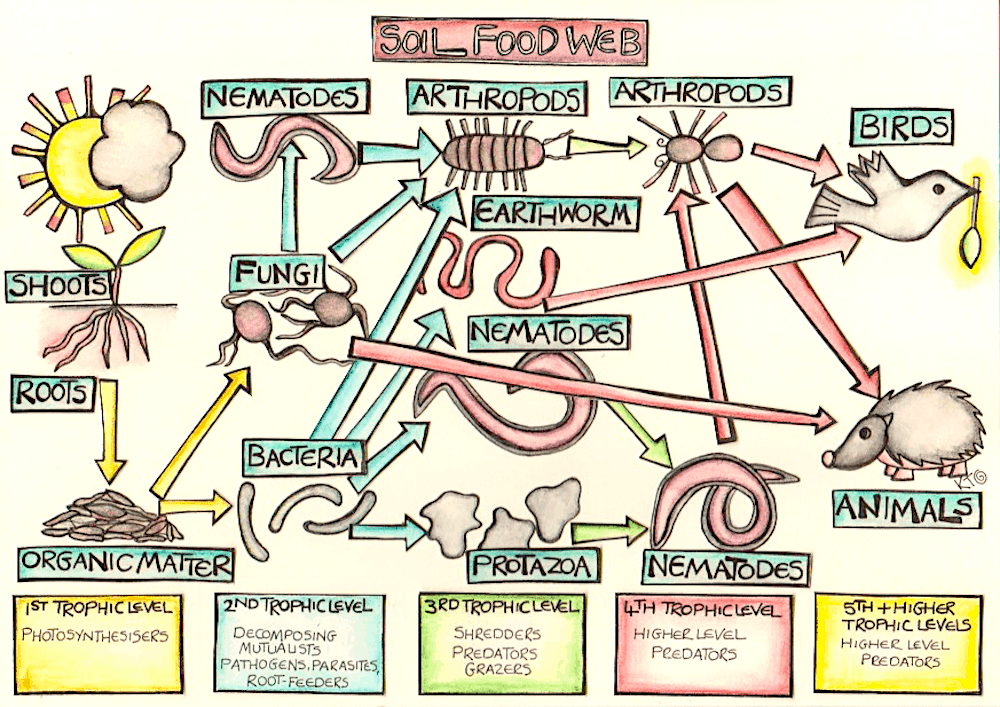
The soil food web is the network of organisms that live in or near the soil and depend on food sources there. It includes bacteria, fungi, protozoa, nematodes, mites, springtails, earthworms, and many other small animals.
Plant roots provide more than a place for a plant to stand. They release small amounts of sugars and other compounds into the soil. These root releases, called root exudates, feed some microbes and help shape the life around the roots.
Dead leaves, old roots, fallen fruit, and animal waste also enter the soil food web. Fungi and bacteria break down much of this material. Small soil animals feed on the microbes or help break larger pieces into smaller parts.
Some nematodes and protozoa feed on bacteria and fungi. Predatory mites and other soil animals feed on smaller organisms. These feeding links help move nutrients through the soil community.
Earthworms are important soil animals, but they should not be confused with microbes. They eat soil and organic matter, mix materials, and create channels. These actions can help soil structure and water movement.
Source: freepermaculture.com
Bacteria
Break down many forms of organic matter and take part in nutrient cycling.
Fungi
Break down plant material and, in the case of mycorrhizal fungi, form useful partnerships with plant roots.
Protozoa
Feed on bacteria and other tiny organisms. Their feeding can help release nutrients in forms that plants may use.
Nematodes
Different types feed on roots, bacteria, fungi, or other small soil animals.
Springtails and mites
Many feed on fungi, microbes, or decaying material. Some mites are predators.
Earthworms
Shred and mix organic matter, create soil channels, and produce nutrient-rich castings.
How Do Decomposers Return Nutrients to Plants?
When leaves or dead roots fall into a garden, they do not become plant food at once. They must first be broken down by many organisms. Larger soil animals may shred the material, while fungi and bacteria break it down further.
As these organisms feed, grow, and release waste, nutrients move through the soil. Microbes also change nutrients into different forms. Some of these forms can then be taken up by plant roots.
This process is called nutrient cycling. It does not mean that every dead leaf turns into food for the plant beside it. Nutrient movement depends on soil moisture, temperature, material type, and the organisms present.
Why Does Soil Disturbance Matter?
Soil organisms need food, air, water, and a place to live. Heavy or frequent digging can break fungal networks and disturb soil habitats. Compaction can also limit air and water movement.
A layer of suitable mulch, healthy roots, and mature compost can help provide food and cover. These steps support soil organisms while helping the soil hold water and resist erosion.
Other Relationships That Shape a Garden Food Web
Not every useful garden relationship involves one organism eating another. Some species work together, while others compete for the same food, water, or space. These links can change how food moves through the garden.
Pollination is one clear example. Bees get food from flowers, and plants gain help with pollen transfer. Both organisms can benefit from this relationship.
Mycorrhizal fungi form partnerships with many plant roots. The plant provides carbon made through photosynthesis. The fungi can help the plant take up water and nutrients from the soil. The exact benefit depends on the plant, fungus, and growing conditions.
Competition also matters. Plants may compete for light, water, and nutrients. Birds may compete for seeds or insects. Predators may compete for the same prey. When one food source becomes scarce, some animals may switch to another source.
Parasites and parasitoids add more links. A parasite uses a host for food or shelter, often without killing it at once. A parasitoid develops in or on a host and usually kills it. These relationships can help shape animal numbers in a garden.
Mutualism
Two species benefit from a relationship, such as a flowering plant and a pollinating bee.
Competition
Two or more organisms need the same limited food, space, light, or other resource.
Parasitism
One organism gains food or shelter from a host, which may suffer harm.
Predation
One animal catches and eats another animal.
Decomposition
Organisms break down dead material and help move nutrients through the ecosystem.
Can One Species Have More Than One Role?
Yes. An organism can take part in several relationships. An adult bird may eat seeds, fruit, and insects. It may also feed insects to its young. A spider may hunt plant pests but may also eat pollinators and other predators.
The same is true for soil life. Some mites feed on fungi, while others hunt small animals. A species name alone does not always tell you its full role. Its life stage, food source, and habitat all matter.
How to Support a Healthy Garden Food Web
You can support a garden food web by giving many kinds of organisms the food and shelter they need. The aim is not to bring every possible animal into the garden. It is to create a suitable mix of plants, soil cover, water, and safe habitat for local wildlife.
Start with the plants and animals already present. Watch the garden through the growing season. Look for feeding marks, flowers, insects, birds, fallen leaves, and signs of soil life. This gives you a useful starting point before you make changes.
Source: primary.cleapss.org.uk
Step 1: Grow a mix of plants
Use trees, shrubs, grasses, flowers, and groundcovers that suit your soil, light, and local climate. Include regionally native plants where practical.
Step 2: Provide flowers across the season
Choose plants with different bloom times so bees, flies, butterflies, and adult predatory insects can find food over a longer period.
Step 3: Keep useful shelter
Leave some leaf litter, safe brush piles, suitable logs, and plant stems where they do not create a fire, disease, or pest risk.
Step 4: Protect the soil
Use suitable mulch and compost, keep soil covered with plants where possible, and avoid needless digging or compaction.
Step 5: Limit pesticide harm
Identify the pest first. Avoid routine broad spraying and choose the least risky control that fits the problem.
Step 6: Keep some natural food sources
Allow a modest level of harmless plant feeding where possible. These insects can feed predators and help them remain in the garden.
Choose Plants That Support Local Wildlife
Plant choice affects which animals can live and feed in a garden. Many insects need certain plants during one or more stages of life. Some caterpillars, for example, can feed only on a limited group of host plants.
Regionally native plants can be a useful starting point because they are part of local ecological systems. They may support insects that have close links with local plant species. However, the best plant list depends on the region, soil, water, and garden conditions.
Non-invasive garden plants can also provide nectar, pollen, fruit, or shelter. A mixed planting plan is often more useful than relying on one plant type. Check local Cooperative Extension and native plant resources before choosing species.
Keep Habitat for Small Garden Animals
Small animals need places to hide, rest, nest, and survive cold or dry periods. A small log pile can shelter beetles and other invertebrates. Leaf litter can provide food and cover for insects, spiders, and other soil animals.
Some native bees nest in bare, well-drained soil. If suitable for your site, leave a small area of undisturbed soil rather than covering every space with thick mulch. Keep the area away from places where digging or foot traffic will disturb nests.
Water can also help wildlife. Use a shallow dish or safe water feature with stones or other firm surfaces that allow small animals to climb out. Keep the water clean and prevent it from becoming a breeding place for unwanted mosquitoes.
Build a Better Soil Environment
Healthy soil needs organic matter, air, and water. Add mature compost when the soil needs it. Use leaves or other suitable organic mulch to cover bare ground and protect the soil surface.
Avoid working wet soil when it is easy to compact. Keep heavy foot traffic off growing beds. Use paths or stepping stones so soil around plant roots stays loose.
Do not remove every fallen leaf or dead stem at once. Some can remain as food and shelter. Remove material when it carries a serious disease, invasive seeds, or another clear risk. Follow local fire and pest guidance where it applies.
A Practical Example: Follow the Food Web in a Vegetable Garden
A small vegetable bed can show many food web relationships at once. Imagine a bed with tomatoes, lettuce, flowering herbs, and a few native flowers nearby. The plants use sunlight to grow and offer food to insects and other animals.
Aphids may gather on young plant growth. Caterpillars may chew leaves, while bees visit the flowers. Lady beetles and lacewing larvae may hunt aphids. Some spiders may catch flies or other insects among the leaves.
At the soil surface, fallen leaves and plant pieces become food for springtails, pillbugs, and other small animals. Fungi and bacteria break down the material. Earthworms may mix the remains into the soil.
A bird may visit the bed to search for insects. It may eat a caterpillar or beetle, while another predator may hunt the bird. These links connect the vegetable bed to the wider yard.
The gardener also plays a role. Harvesting removes some plant material and nutrients from the system. Adding compost and returning suitable plant waste can help replace some organic matter. Watering, pruning, and pest control can also change the food web.
Tomato plant
Uses sunlight to make food and provides leaves, flowers, and fruit.
Aphids and caterpillars
Feed on plant tissues or sap and may become food for predators.
Lady beetles and lacewing larvae
Hunt aphids and other small insects on the plants.
Bees and hoverflies
Visit flowers for food. Some hoverfly larvae also feed on aphids.
Birds and spiders
Feed on a range of insects and connect the vegetable bed with higher feeding levels.
Soil organisms
Process fallen plant material and help cycle nutrients through the soil.
How Can You Read This Food Web?
Follow each food source toward the organism that uses it. Tomato leaves feed some plant eaters. Those plant eaters may feed predators. Dead leaves and roots enter a separate but connected path through soil organisms.
Notice that the same garden supports more than one food path. A flowering herb can feed a bee and a hoverfly. The hoverfly’s young may then feed on aphids. This makes the plant part of several different relationships.
The example is a model, not a promise that every species will appear in every vegetable bed. Local wildlife, weather, season, and plant choice all affect which links are present.
How to Know When the Garden Food Web Needs Help
A healthy food web does not mean a garden without insects or damaged leaves. It means that different organisms have suitable food and habitat, and that natural processes can continue. A few chewed leaves or aphids do not prove that something is wrong.
Look at plant health, the amount of damage, and the insects present. Check whether new leaves are growing. Look for predator larvae or other natural enemies. Also check whether plants have enough water, light, and space.
If a pest population grows, identify it before acting. Some insects look alike but have very different roles. A pest can also be present without causing serious harm. Correct identification helps prevent needless treatment.
Many aphids but little plant damage
Monitor the plant and look for lady beetles, lacewing larvae, and hoverfly larvae. Treatment may not be needed.
Leaves have large holes
Check for caterpillars, slugs, beetles, and other leaf feeders. Identify the animal and assess the amount of damage.
Few pollinators visit flowers
Check flower supply, bloom timing, plant choice, water, and possible pesticide exposure.
Soil stays bare and dry
Consider suitable mulch, groundcover, compost, and better watering practices.
Predators are hard to find
Review plant diversity, shelter, flowering resources, and pesticide use. Natural enemies may need time to arrive.
Use Integrated Pest Management Before Spraying
Integrated Pest Management, or IPM, is a step-by-step way to manage pests. The U.S. Environmental Protection Agency explains that IPM uses pest identification, monitoring, prevention, and suitable control methods. It can be used in home gardens as well as farms.
First, identify the organism and check the damage. Next, decide whether the problem is serious enough to need action. A single insect does not always mean that a plant needs treatment.
Use simple controls first when they fit the problem. These may include removing a badly affected plant part, using a barrier, or washing some soft-bodied insects from a plant with water. Keep checking the plant after taking action.
If a pesticide is needed, choose a product labeled for the target pest and plant. Follow every label direction. Consider effects on pollinators, predators, pets, people, and other wildlife. Avoid broad treatment when a more targeted method will work.
What If Natural Predators Do Not Control the Pest?
Natural predators may arrive after a pest population has already grown. Some pests reproduce quickly, while many predators need more time to find food, lay eggs, and produce young. This delay is normal in many garden systems.
Check whether the plant is under stress. Poor watering, excess fertilizer, and other growing problems can make some pest issues harder to manage. Also look for ants tending aphids or signs that pesticides have harmed natural enemies.
If damage continues, use an IPM method suited to the exact pest. A local Cooperative Extension office can help with identification and region-specific advice. Do not assume that adding more predators will solve every problem.
Common Mistakes When Understanding Garden Food Webs
A food web can be complex, but a few simple mistakes can lead to poor garden decisions. The biggest mistake is judging an organism by whether it eats a plant. Many plant feeders also provide food for predators and other wildlife.
A better approach is to look at the full relationship. Ask what an organism eats, what eats it, and how it affects the plant or soil. This gives a clearer view than calling every insect good or bad.
Removing every insect
This can remove food for birds and natural predators. Identify insects before deciding whether control is needed.
Treating every aphid as a threat
Small aphid groups may cause little harm. Check plant health and monitor their natural enemies first.
Thinking predators eat only pests
Many predators are generalists. They may eat pests, pollinators, and other predators.
Removing all fallen leaves
This removes some food and shelter for soil animals. Keep suitable leaves where they do not create a clear risk.
Assuming all soil animals are decomposers
Some eat dead matter, some eat microbes, and others hunt living animals. Their roles are different.
Expecting instant natural pest control
Predator numbers may rise slowly. A diverse garden supports natural enemies but does not guarantee pest-free plants.
Using one plant list across the country
Wildlife needs differ by region. Choose plants that suit local conditions and do not introduce invasive species.
Does More Biodiversity Always Mean Fewer Pests?
More kinds of plants and animals can provide more food paths and habitat. This can support predators, pollinators, and decomposers. However, it does not mean that every pest will disappear.
Some plant feeders may increase when their host plants are abundant. Some predators may feed on other helpful insects. Weather and seasonal changes can also affect pest numbers.
The aim is a garden with many useful ecological links, not a system with no plant damage. Good plant care and careful monitoring remain part of the plan.
Useful Next Questions and Research Gaps
A review of five explanatory garden and soil food web resources, published by the Wildlife Gardening Forum, the Royal Horticultural Society, Colorado State University, and the USDA Natural Resources Conservation Service, shows several useful areas of coverage. The reviewed pages explain feeding roles, simple food chains, soil organisms, and ways to protect soil life.
Additional U.S. guidance from the University of Minnesota Extension explains aphid predators and natural pest control. The U.S. Environmental Protection Agency explains the main steps of Integrated Pest Management. These sources help connect ecological ideas with practical garden decisions.
The research was checked on November 16, 2026. Search topics included garden food web relationships, garden food chains, soil food webs, and beneficial garden insects. The target market is the United States. Research on British native plants was treated as UK-specific and was not used as a direct planting prescription for U.S. gardens.
The questions below are inferred next needs, not verified search queries. No private Search Console data, customer questions, or People Also Ask records were supplied or checked. The coverage labels refer only to the pages reviewed, not to every page available online.
INFERRED NEXT NEED: How do soil organisms connect with insects above ground?
Reader stage: Learning how the whole garden works. Reviewed coverage: SHALLOW. Soil-focused pages explain microbes and nutrient cycling, while garden food web pages explain visible animals. This guide joins both paths. Evidence basis: USDA NRCS, Colorado State University, and UC Davis soil food web material. Priority: High.
INFERRED NEXT NEED: Why do aphids remain when predators are present?
Reader stage: Managing a garden pest. Reviewed coverage: ANSWERED for aphids, but SHALLOW in general food web guides. University of Minnesota Extension explains that predators may take time to catch up with fast-growing aphid populations. This guide adds monitoring and plant-health checks. Priority: High.
INFERRED NEXT NEED: Which plants support local predators and pollinators?
Reader stage: Planning a wildlife-friendly garden. Reviewed coverage: SHALLOW for U.S. regional choices. The reviewed Royal Horticultural Society planting research is based on British plants and conditions. This guide recommends local native plant lists and Cooperative Extension advice instead of transferring UK findings. Priority: High.
INFERRED NEXT NEED: When should a gardener control a pest?
Reader stage: Choosing an action. Reviewed coverage: ANSWERED in EPA IPM guidance, but not always linked to the full garden food web. This guide connects pest identification, damage checks, natural enemies, and targeted control. Priority: High.
INFERRED NEXT NEED: How can a gardener support soil life without harming other wildlife?
Reader stage: Improving soil and habitat. Reviewed coverage: ANSWERED for soil care in the Colorado State and USDA resources, but SHALLOW on the links to above-ground animals. This guide combines soil cover, organic matter, habitat, and careful pesticide use. Priority: Medium.
What Evidence Should Gardeners Use?
Use local Cooperative Extension guidance for plant choice, pest identification, and regional growing conditions. Use USDA Natural Resources Conservation Service material to learn about soil organisms and soil health. Use EPA guidance when making decisions about pest control.
A food web diagram is a useful learning tool, but it cannot show every species or feeding link in a real garden. Treat examples as possible relationships and check local species before making a management decision.
Frequently Asked Questions
Q
What is an example of a garden food web?
A simple example starts with a leafy plant. Aphids and caterpillars feed on its leaves or sap. Lady beetles and lacewing larvae eat some of these insects, while birds may eat caterpillars and beetles. Fallen leaves then support soil animals, fungi, and bacteria that help recycle nutrients.
Q
What is the difference between a food web and a food chain?
A food chain shows one feeding path. A food web shows many connected feeding paths. A caterpillar may be eaten by several predators, and each predator may hunt several types of prey. The web gives a better picture of a real garden.
Q
Are all insects important in a garden food web?
Many insects have useful roles, but their effects differ. Some pollinate flowers, some eat plants, and others hunt pests. Even plant feeders can provide food for birds and predators. Their value depends on the species, number, and effect on the garden.
Q
How do earthworms help the garden food web?
Earthworms eat and mix organic material and soil. They create channels that can help air and water move through the soil. Their castings also add processed organic material. They are important soil animals, but fungi and bacteria do much of the chemical breakdown of dead matter.
Q
How can I make my garden food web stronger?
Grow a range of suitable plants, provide flowers through the growing season, keep some safe leaf litter and shelter, and protect the soil with plants or mulch. Avoid needless pesticide use and identify pests before taking action. Choose plants and habitat features that fit your local climate and wildlife.
✦ Wrapping Up
Conclusion
Garden food web relationships connect every part of a living garden. Plants capture sunlight and provide food. Herbivores feed on plants, predators feed on animals, and decomposers break down dead material. Soil organisms help cycle nutrients and support the next round of plant growth.
These links explain why a garden needs more than flowers and vegetables. It also needs insects, birds, soil life, shelter, and suitable food sources. A few chewed leaves or aphids do not always mean that a garden has a problem. They may be part of a normal feeding relationship.
You can support these links with diverse plants, suitable native species, healthy soil, safe habitat, and careful pest control. Watch what lives in your garden before making changes. Small steps can help build a more varied and resilient outdoor space.
💡 Key Takeaway
Start with one garden bed. Record the plants, plant feeders, predators, pollinators, and soil animals you find. Keep suitable leaf litter, add regionally appropriate plants, protect the soil, and avoid unnecessary pesticide use. Review the bed through the seasons to see how its food web changes.