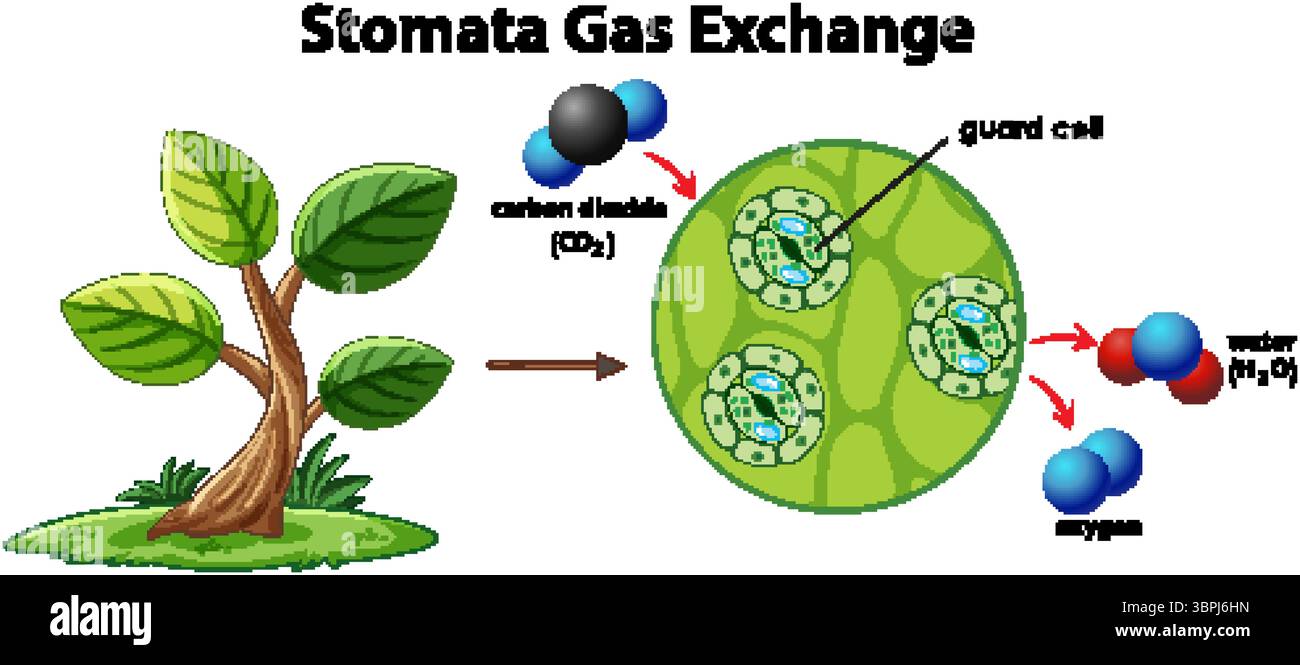
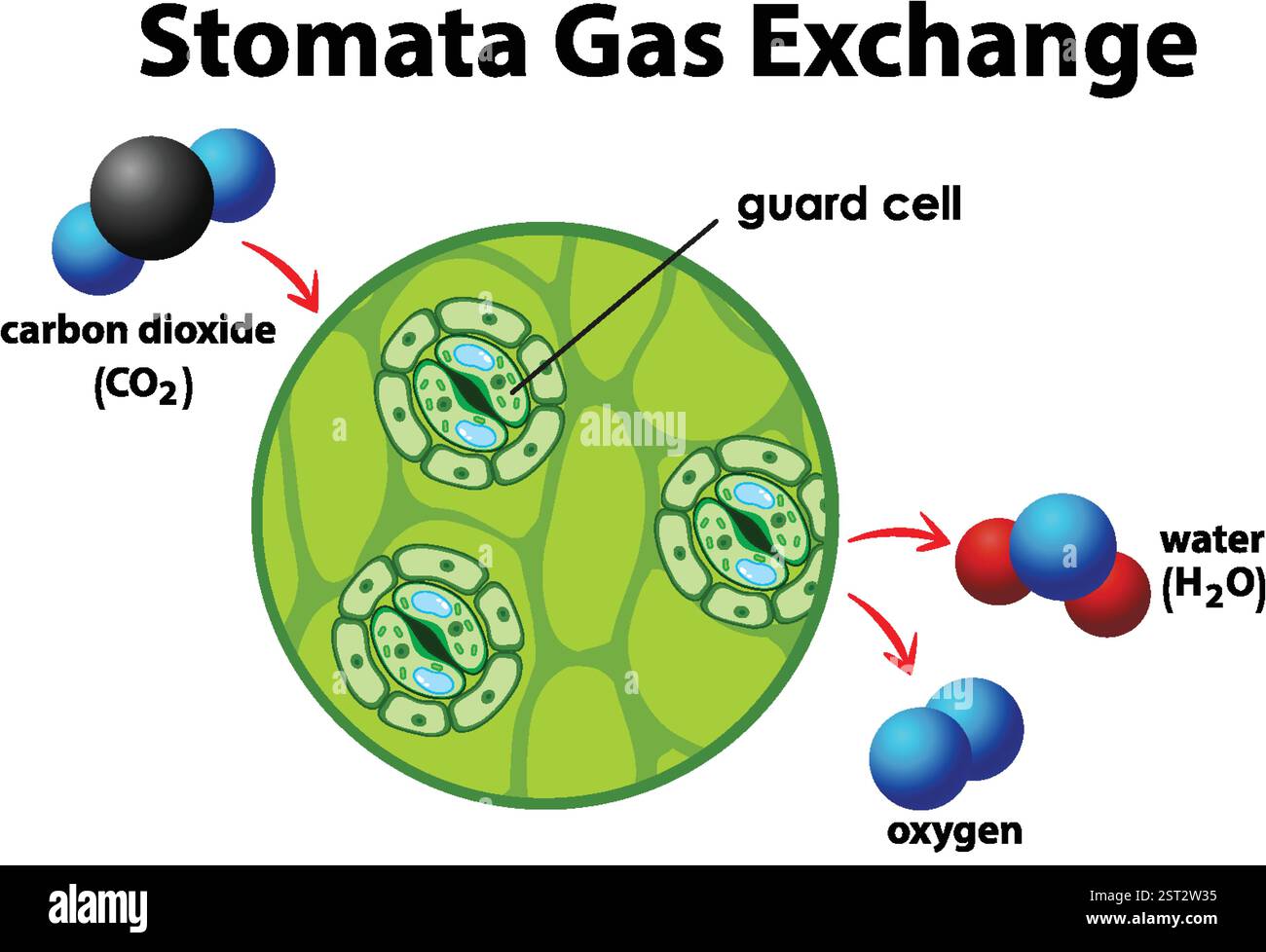
Plant stomata are tiny pores on plant surfaces. They let carbon dioxide enter and allow oxygen and water vapor to leave. Special cells called guard cells control these pores. This helps plants balance food production with water savings.
Across the United States, plants face very different growing conditions. A tomato plant in a hot Texas garden, a corn crop in Iowa, and a maple tree in New England all need air, water, and sunlight. Each plant uses small openings called stomata to manage gas exchange. These openings help leaves take in carbon dioxide and release oxygen and water vapor.
Stomata are small, but their role is huge. They help control photosynthesis, plant respiration, and water loss. Two special cells, called guard cells, open and close each pore. Their actions depend on light, water supply, temperature, and other signals. This control helps a plant grow without losing too much water.
Understanding stomata can explain many things that happen in a garden. It helps explain why plants may close their leaf pores during a dry spell. It also shows why a plant may slow its growth during extreme heat. This guide explains how stomata work, how gases move, and how plants manage the trade-off between carbon intake and water loss.
Source: alamy.com
What Are Plant Stomata and Where Are They Found?
Stomata are small openings in the outer layer of a plant. The word stoma means one opening. Stomata means more than one. These pores connect the air outside a plant with air spaces inside its tissues.
Most land plants have stomata on their leaves. Many have more on the lower leaf surface. This location can help reduce water loss from direct sunlight and heat. Some plants have stomata on both leaf surfaces. Their number and location vary by plant type and habitat.
Stomata also occur on some stems and other green plant parts. They are not found in the same way on every plant. Some plants use other structures for gas exchange. For example, woody stems have small openings called lenticels.
Source: livephysics.com
Stoma
One small pore that allows gases and water vapor to move between plant tissues and the outside air.
Stomata
The plural form of stoma. These pores are common on leaves and some green stems.
Guard cells
A pair of special cells that control the size of a stomatal pore.
Subsidiary cells
Nearby cells that may help guard cells work and support stomatal movement.
The Main Parts of a Stomatal Complex
A stomatal complex includes a pore, two guard cells, and sometimes nearby subsidiary cells. The guard cells sit on each side of the pore. Their shape and water content help control the opening.
In many broadleaf plants, guard cells look like small curved beans. In grasses, they often have a dumbbell shape. These different forms help plants control gas movement in ways that suit their leaf structure.
Stomatal pore
The open space between the guard cells. It is the main route for gas movement.
Guard cell walls
Their uneven thickness and structure help the cells bend as their water content changes.
Chloroplasts
Small structures inside guard cells that help them sense and respond to light.
Why Are Most Stomata on the Lower Leaf Surface?
The lower side of a leaf is often cooler and less exposed to direct sunlight. Placing many stomata there can help reduce water loss. It still allows carbon dioxide to enter the leaf.
This pattern is common, but it is not a rule for every plant. Floating leaves may have stomata on their upper surface because the lower surface touches water. Some grasses and other plants have stomata on both sides.
Lower leaf surface
Often holds many stomata in plants that grow on land.
Upper leaf surface
May also contain stomata, especially in plants with special leaf forms.
Sunken stomata
Some plants place their pores in small pits. These pits can trap moist air and slow water loss.
How Gas Exchange Happens Inside a Leaf
Gas exchange happens mainly through diffusion. Diffusion is the movement of particles from an area with more particles to an area with fewer particles. Plants do not need lungs or a pump to move these gases. They use natural concentration differences.
When photosynthesis is active, leaf cells use carbon dioxide. This lowers the carbon dioxide level inside the leaf. If the stomata are open, carbon dioxide from the outside air moves into the leaf.
The gas passes through the stomatal pore and enters the air spaces between mesophyll cells. Mesophyll cells are the main photosynthetic cells in a leaf. Carbon dioxide then moves into these cells, where chloroplasts use it to make sugars.
Oxygen is produced during the light reactions of photosynthesis. When its level inside the leaf becomes higher than the level outside, oxygen can move out through the stomata. Water vapor also moves out through the same opening.
Source: elearning.reb.rw
Carbon dioxide enters
CO2 moves from the outside air into the leaf. Photosynthesis uses this gas to build sugars.
Oxygen leaves
O2 made during photosynthesis can move from the leaf into the air.
Water vapor leaves
Water changes into vapor inside the leaf and moves out through open stomata.
Diffusion drives movement
Gases move along concentration gradients. They do not need a special breathing organ.
The Role of Mesophyll Cells
The mesophyll is the inner tissue of a leaf. It has two main parts in many broadleaf plants. The upper part is called the palisade mesophyll. The lower part is called the spongy mesophyll.
Palisade cells are packed with chloroplasts. They do much of the work of photosynthesis. Spongy mesophyll cells are more loosely arranged. Their spaces allow gases to move through the leaf.
These air spaces connect with the stomatal pores. This creates a path for carbon dioxide to reach photosynthetic cells. It also gives oxygen and water vapor a path out.
Palisade mesophyll
A layer of cells that absorbs light and carries out much of the leaf’s photosynthesis.
Spongy mesophyll
A loose layer with air spaces that help gases move through the leaf.
Leaf cuticle
A waxy outer layer that slows water loss from leaf surfaces.
How Photosynthesis and Respiration Affect Gas Movement
Photosynthesis uses carbon dioxide and water to make sugars. It also releases oxygen. Light provides the energy for this process. A simple summary is that carbon dioxide enters while oxygen leaves during active photosynthesis.
Plant respiration works in a different way. It uses oxygen to break down sugars and release usable energy. It also produces carbon dioxide. Respiration happens day and night because plant cells need energy all the time.
This means gas movement is not always the same. During strong photosynthesis, a leaf often takes in more carbon dioxide than it releases. At night, photosynthesis stops or slows greatly, while respiration continues. Oxygen may then enter and carbon dioxide may leave.
During daylight
Photosynthesis often uses more carbon dioxide than respiration produces. Net carbon dioxide movement is usually inward.
During darkness
Respiration continues without normal light-driven photosynthesis. Net carbon dioxide movement may be outward.
During all hours
Respiration continues in living plant cells, even when the plant is not making sugars through photosynthesis.
How Guard Cells Open and Close Stomata
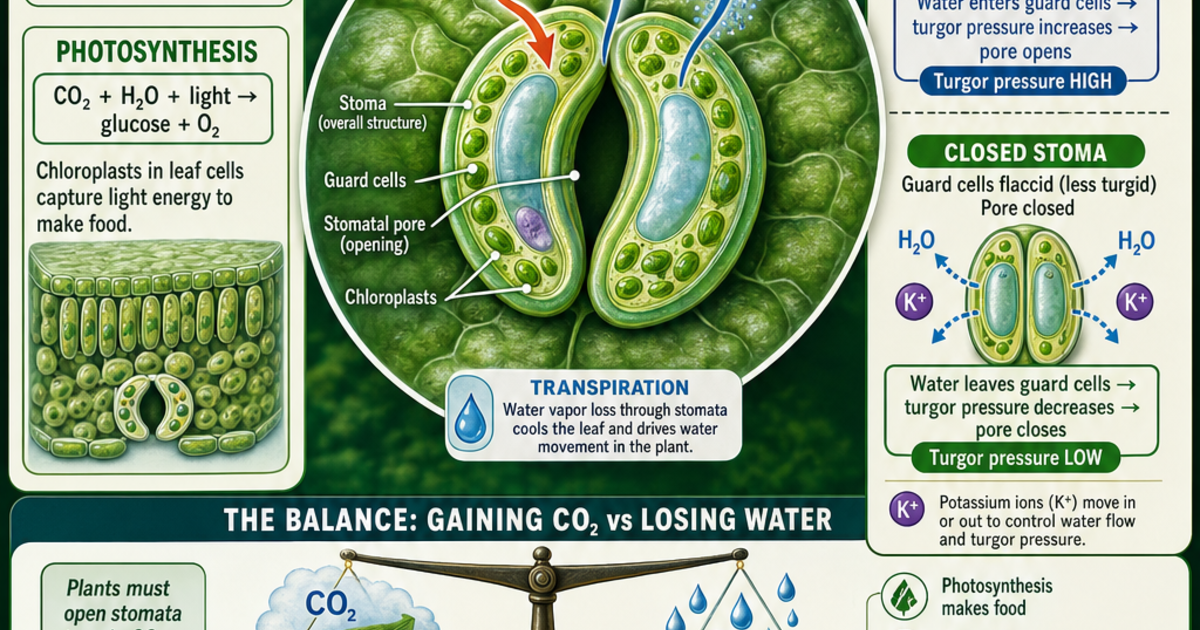
Guard cells open and close stomata by changing their water content and shape. When they take in water, they become firm. This state is called turgid. The cells bend apart and make the pore wider.
When guard cells lose water, they become less firm. This state is called flaccid. The cells move closer together, and the pore becomes smaller or closes. This change helps reduce water loss when the plant faces dry conditions.
The process depends on water movement across cell membranes. Small charged particles called ions help control that movement. Potassium ions play a key role in many plants.
Source: livephysics.com
Open stomata
Guard cells have gained water and become firm. The pore becomes wider and allows more gas movement.
Closed stomata
Guard cells have lost water and become less firm. The pore becomes narrow or shuts.
Osmosis
Water moves across a membrane toward the side with lower water potential.
What Happens When a Stoma Opens?
Light can start a chain of events inside guard cells. Blue light is an important signal in many plants. It activates special pumps in the guard cell membrane.
These pumps move hydrogen ions out of the guard cells. This helps potassium ions move into the cells. Other ions, such as chloride and malate, may also help balance the charge.
As solutes build up, the water potential inside the guard cells falls. Water then moves into them by osmosis. The cells swell and bend away from each other. The pore opens, allowing gas exchange.
Light signal
Blue light can activate processes that help guard cells prepare to open.
Ion movement
Potassium and other ions build up inside the guard cells.
Water enters
Water moves into the guard cells by osmosis.
Pore opens
Higher cell pressure changes the shape of the guard cells and widens the pore.
What Happens When a Stoma Closes?
Stomata close when guard cells lose water and pressure. Potassium and other ions can move out of the cells. Water then follows, and the guard cells become less firm.
A plant hormone called abscisic acid, or ABA, helps control this response. Plants often make more ABA during water stress. This hormone sends signals that help guard cells release ions and water.
Closure limits water loss. However, it also reduces carbon dioxide entry. This can slow photosynthesis and plant growth if the closure lasts for a long time.
Water stress
A dry root zone or high water loss can start signals that lead to stomatal closure.
ABA signals
Abscisic acid helps guard cells respond to drought and other water stress.
Reduced gas flow
A smaller pore limits both carbon dioxide entry and water vapor loss.
Why Guard Cell Shape Matters
Guard cells do not swell like simple round water balloons. Their walls have different thicknesses. The wall beside the pore is often thicker and less flexible than the outer wall.
The arrangement of cellulose fibers also affects how each cell bends. As the cells gain water, they curve away from the pore. This creates an opening instead of forcing the cells together.
This design gives plants a way to control gas exchange with small changes in cell pressure. It is a simple structure with a very useful result.
Uneven wall thickness
Helps the guard cells bend in a useful direction.
Cellulose fibers
Help guide the shape change as guard cells gain or lose water.
What Makes Plant Stomata Open or Close?
Stomata respond to several signals at once. Light is one major signal, but it is not the only one. Water supply, carbon dioxide, temperature, and air moisture also affect the size of each pore.
A plant does not follow one fixed rule every day. It responds to the conditions around its leaves and roots. This helps it adjust gas exchange as the weather and water supply change.
Source: alamy.com
Light
Many plants open their stomata when daylight begins because photosynthesis needs carbon dioxide.
Carbon dioxide
Low carbon dioxide inside a leaf can support opening. High internal levels can reduce the need for a wide opening.
Soil moisture
Dry soil can trigger water stress signals that lead to stomatal closure.
Air humidity
Dry air can increase water loss and may cause stomata to close.
Temperature
Moderate warmth can support activity, while extreme heat may increase water stress and lead to closure.
Wind
Wind can remove moist air near the leaf surface and increase the rate of water loss.
How Light Affects Stomatal Movement
Many plants open their stomata after sunrise. Light signals that photosynthesis can begin. Guard cells respond to light and start the ion movement that allows water to enter.
At night, many plants close their stomata. Photosynthesis needs light, so the plant may not need as much carbon dioxide. Closing the pores can also save water.
This pattern can change with plant type and growing conditions. Some plants open their stomata during the day even when the light is weak. Others follow a different daily rhythm.
Morning
Light can help trigger stomatal opening and support early photosynthesis.
Midday
Strong heat and dry air may cause partial closure, even when light remains high.
Night
Many plants reduce stomatal opening, although night-opening plants are an important exception.
How Dry Air and Heat Affect Stomata
A leaf loses water faster when the air is dry. The difference in water vapor between the leaf and the air creates a strong pull. This is linked to a measure called vapor pressure deficit, or VPD.
High VPD can increase transpiration. If the roots cannot replace the lost water, the leaf may lose pressure. Guard cells can then reduce the pore opening to limit further loss.
Heat can make this problem worse. A plant may lose water quickly on a hot, dry day. Some plants can use transpiration to cool their leaves, but this cooling has a water cost.
High humidity
Often lowers the difference in water vapor between the leaf and air, reducing transpiration.
Low humidity
Can raise the rate of water loss when stomata are open.
High VPD
Can place extra demand on the plant’s water supply and lead to partial or full closure.
Why Water Supply Matters
Roots take up water from the soil and send it through the xylem. The xylem is a set of water-carrying tissues. Water moves from the roots through the stem and into the leaves.
When soil water is low, roots may send chemical signals that help leaves conserve water. Guard cells may lose pressure and close the pores. This can protect the plant during a dry spell.
Water supply alone does not control every response. A plant can close its stomata even when soil water is present if the air is very dry or the leaf is too hot. The plant responds to the whole water balance.
Healthy water supply
Helps maintain cell pressure and supports normal leaf function.
Dry soil
Can lead to root signals and lower guard cell pressure.
Poor root health
Can limit water uptake even when the soil appears moist.
How Stomata Balance Photosynthesis and Water Loss
Stomata help plants solve a daily problem. Plants need carbon dioxide to make food, but open pores also allow water to escape. A plant must balance these two needs.
When stomata open, carbon dioxide can enter. This supports photosynthesis and sugar production. At the same time, water vapor leaves the leaf through transpiration.
When stomata close, the plant saves water. But less carbon dioxide can enter. This can slow photosynthesis. A plant that keeps its stomata closed for too long may grow more slowly.
This balance affects plant growth, crop yield, and survival. It is also one reason why plants in dry regions often have special leaf shapes and stomatal patterns.
Source: alamy.com
More open stomata
Usually allow more carbon dioxide to enter, but can also increase water loss.
More closed stomata
Help conserve water, but may limit carbon dioxide supply and photosynthesis.
Balanced opening
Helps a plant gain carbon while keeping water loss within a level it can support.
What Is Transpiration?
Transpiration is the loss of water vapor from a plant. Much of this loss takes place through stomata. Water first enters the plant through the roots and moves upward through the xylem.
Inside a leaf, water evaporates from moist cell walls into the air spaces. It then moves out through open stomata. This loss helps pull more water upward from the roots.
Transpiration also helps cool leaves. When water evaporates, it takes heat from the leaf surface. This can help a plant avoid overheating, especially when the sun is strong.
Water uptake
Roots absorb water from the soil.
Water transport
Xylem carries water from roots toward the leaves.
Evaporation
Water changes into vapor inside the leaf.
Water release
Water vapor moves through stomata into the surrounding air.
What Is Water-Use Efficiency?
Water-use efficiency describes how much carbon a plant gains compared with how much water it loses. It helps explain why some plants grow well with less water than others.
A plant may improve its water-use efficiency by taking in more carbon dioxide for each unit of water lost. It may also reduce water loss by closing stomata during dry periods.
There is no single value that fits every plant. Water-use efficiency changes with species, weather, soil, leaf age, and how the measurement is made. It is best used as a way to compare plants under clear and similar conditions.
Carbon gain
The amount of carbon fixed through photosynthesis.
Water loss
The water released through transpiration.
Better balance
A plant may gain more carbon while losing less water under suitable conditions.
Why Stomata Matter for Plant Cooling
Transpiration can help keep leaves cooler than they would be without water loss. This is useful in warm places across the United States, especially during hot summer days.
However, cooling needs water. If the plant cannot replace the water that leaves its tissues, it may close its stomata. This reduces cooling and can raise leaf temperature.
This is why plants need a steady balance between water supply, leaf temperature, and air conditions. More open stomata are not always better.
Cooling benefit
Evaporation can remove heat from the leaf.
Water cost
Cooling through transpiration uses water that the roots must replace.
How Different Plants Adapt Their Stomata
Plants do not all manage gas exchange in the same way. Their stomata and leaves reflect the conditions in which they grow. Plants in wet areas may have different features from plants in deserts.
Some plants reduce water loss through small leaves, thick cuticles, sunken stomata, or a lower number of pores. Others use special photosynthesis pathways that change when they take in carbon dioxide.
These features help plants survive in their own habitats. They also show that stomatal control is part of a larger set of plant adaptations.
Desert plants
May have thick leaves, sunken stomata, or special timing that helps save water.
Grass species
Often have dumbbell-shaped guard cells that support fast stomatal movement.
Aquatic plants
May have stomata on the upper leaf surface when the lower surface rests on water.
Forest plants
May have leaf shapes and stomatal patterns suited to shade and moist air.
C3 and C4 Plants
C3 plants use the common first step of carbon fixation in photosynthesis. Many garden plants, trees, and cool-season crops use this pathway. Their stomata often open during the day to let carbon dioxide enter.
C4 plants use an extra carbon-fixing step. This helps them concentrate carbon dioxide near the enzymes that run the main photosynthesis cycle. Many warm-season grasses, including corn, use this pathway.
This system can help C4 plants use water more efficiently in hot, bright conditions. It does not mean they never lose water. They still need stomata for gas exchange and water control.
C3 plants
Use the common carbon fixation pathway and may face greater limits under hot, dry conditions.
C4 plants
Concentrate carbon dioxide inside the leaf and can often support strong photosynthesis with less stomatal opening.
CAM Plants and Night-Time Stomatal Opening
Some desert plants use a pathway called crassulacean acid metabolism, or CAM. Cacti and many succulents use this method. They often open their stomata at night, when the air is cooler and water loss may be lower.
At night, they take in carbon dioxide and store it in the form of organic acids. During the day, they keep their stomata mostly closed and release the stored carbon dioxide inside the leaf for photosynthesis.
This timing helps CAM plants save water. It is useful in dry places where water is hard to find. Not every succulent uses CAM, so this feature should not be assumed for all plants with thick leaves.
Night-time opening
Stomata open when air is often cooler and water loss can be lower.
Carbon storage
The plant stores carbon in organic acids for use during daylight.
Daytime closure
Stomata stay mostly closed while stored carbon supports photosynthesis.
How Leaf Shape Helps Control Water Loss
A plant can reduce water loss through more than stomatal movement. Small leaves have less surface area exposed to the air. Thick cuticles slow evaporation from the outer surface.
Some plants also have leaf hairs. These hairs can trap a layer of still air near the leaf. This may slow water loss under some conditions.
Other plants roll their leaves during dry weather. This can protect some stomata from direct exposure to moving, dry air. These features work with stomata to support water balance.
Thick cuticle
Slows water loss through the outer leaf surface.
Small leaves
Can reduce the total surface area exposed to dry air.
Leaf hairs
May create a calmer layer of air near the leaf surface.
Rolled leaves
Can protect stomata from direct exposure to dry air.
How to Observe Stomata in a Leaf
You can observe stomata with a basic school or home microscope. A simple leaf surface print can show the pores and guard cells. This activity helps connect the structure of a leaf with its role in gas exchange.
A smooth leaf surface often works well. Ferns and many broadleaf plants can provide useful samples. Choose a healthy leaf and avoid damaging a rare or protected plant.
A microscope view can show where stomata are found and how they are arranged. It does not directly measure how much gas moves through them. For that, scientists use special tools such as a porometer or a gas exchange system.
Materials
A fresh leaf, clear tape, clear nail polish, a microscope slide, and a microscope.
Best sample
A healthy leaf with a smooth surface is often easier to study.
Main goal
View stomatal pores and guard cells under magnification.
Steps for Making a Leaf Stomata Print
Start by choosing a healthy leaf. Place a small drop of clear nail polish on a small area of the lower leaf surface. Let the polish dry fully.
Place a piece of clear tape over the dry polish. Press it gently, then lift it away. The thin print should stick to the tape. Place the tape on a clean microscope slide.
Look at the slide under low magnification first. Then increase magnification to see the smaller details. Look for paired guard cells with a narrow opening between them.
Step 1
Choose a healthy leaf and clean, dry microscope slide.
Step 2
Apply a small amount of clear polish to a small area of the leaf.
Step 3
Allow the polish to dry fully before placing tape over it.
Step 4
Lift the tape gently and place the print on the slide.
Step 5
View the sample and identify the stomata and guard cells.
How to Read What You See
Stomata may look like small openings surrounded by two curved cells. Their shape can differ between plant groups. You may see many pores in one area and fewer in another.
Compare the upper and lower leaf surfaces if you want to see how stomatal distribution changes. Use the same microscope settings for both samples. Record what you see rather than assuming every leaf will have the same pattern.
A closed pore may be hard to see in a thin print. Some pores may also look different because of the angle or quality of the sample. A clear image is helpful, but one sample does not show the full range of a plant’s stomatal behavior.
Open pore
The space between guard cells is easy to see.
Closed pore
The guard cells sit close together and the opening looks narrow.
Stomatal pattern
The number and spacing of pores can vary across the leaf.
Safety During the Activity
Use nail polish in a well-ventilated area. Keep it away from flames and heat because many nail polish products contain flammable solvents. Do not apply it to skin or near the eyes.
Young students should complete this activity with adult help. Follow the product label and wash hands after handling the sample. If nail polish is not suitable, use a prepared microscope slide or a safe leaf epidermis sample instead.
Ventilation
Work where fresh air can move through the room.
Fire safety
Keep polish and its fumes away from flames, sparks, and hot surfaces.
Adult help
Children should have adult supervision when using polish and microscope tools.
Common Mistakes About Stomata and Gas Exchange
Many simple explanations of stomata leave out key details. This can lead to wrong ideas about how plants use air and water. Understanding the limits of each process helps explain real plant behavior.
Stomata are not tiny lungs. Plants do not breathe in and out in the same way animals do. They rely on diffusion, cell activity, and water movement to manage gas exchange.
Mistake: Plants only take in carbon dioxide
Plants also use oxygen for respiration. This process continues during the day and night.
Mistake: All stomata open during the day
Many plants follow this pattern, but CAM plants often open their stomata at night.
Mistake: Closed stomata stop all water loss
Water can still escape through the leaf cuticle and other plant surfaces.
Mistake: Every plant has stomata only on the lower leaf surface
Stomatal location varies with plant type and leaf structure.
Mistake: More stomata always mean more photosynthesis
Photosynthesis also depends on light, water, nutrients, temperature, and other limits.
Does a Plant Stop Respiring When Stomata Close?
No. Plant respiration continues inside living cells. It releases energy from stored sugars. Stomatal closure can reduce gas movement, but it does not switch off respiration.
Plants may still exchange some gases through small openings and other routes. They also have internal air spaces that help gases move between cells.
Respiration continues
Living cells still need energy, even when stomata are closed.
Gas movement changes
Closure reduces the main path for exchange but does not stop every form of gas movement.
Do Stomata Control All Water Loss?
No. Stomata control a large part of water loss from many leaves, but water can also escape through the cuticle. This is called cuticular transpiration.
The waxy cuticle slows this loss, but it does not make the leaf fully waterproof. The amount of water lost through the cuticle depends on leaf structure, age, and environmental conditions.
Stomatal water loss
Water vapor moves through open stomatal pores.
Cuticular water loss
A smaller amount of water can pass through the leaf’s outer waxy layer.
Why a Wilted Leaf Does Not Always Mean Closed Stomata
Wilting happens when plant cells lose enough water pressure to make leaves and stems droop. Stomatal closure may occur during this process, but wilting and stomatal movement are not the same thing.
A plant can wilt because roots are damaged, soil is too dry, soil is waterlogged, or heat causes water loss to exceed water uptake. The cause should be checked before changing the watering routine.
Look at the soil, drainage, roots, and recent weather. Do not assume that a wilted plant needs more water. Too much water can also harm roots and limit their ability to take up water.
Check soil moisture
Feel the soil below the surface before adding more water.
Check drainage
Make sure water can leave the pot or growing bed.
Check recent weather
High heat and dry wind may cause short-term water stress.
How to Support Healthy Stomatal Function in a Garden
Healthy stomatal function depends on healthy roots, leaves, and growing conditions. Gardeners cannot control each pore directly. They can, however, help plants maintain a good water balance.
Start with suitable soil and proper watering. Add organic matter where it fits the soil and plant type. Use mulch to slow soil water loss, while keeping mulch away from direct contact with plant stems.
Choose plants that fit the local climate. A drought-tolerant plant may manage hot, dry weather better than a plant that needs steady moisture. Native plants can also be useful choices when they match the site’s soil and light conditions.
Water deeply when needed
Help water reach the root zone instead of wetting only the soil surface.
Improve soil structure
Good soil structure supports root growth, water movement, and air spaces.
Use mulch
Mulch can reduce evaporation from the soil and help keep root zones cooler.
Match plants to the site
Choose species that suit local heat, rainfall, soil, and sunlight.
Avoid excess fertilizer
Use nutrients based on plant needs and soil conditions rather than adding more by guesswork.
What to Do During Hot and Dry Weather
During hot weather, check plants early in the day. Look for drooping leaves, dry soil, and signs of root stress. Water the root zone when the plant and soil need it.
Do not use frequent shallow watering as the only method. It may leave deeper roots dry. A slow, deep watering can help water reach more of the root zone, depending on the soil and plant.
Shade cloth may help some sensitive plants during severe heat. It should match the crop and growing stage. Too much shade can reduce photosynthesis, so use it with care.
Check before watering
Use soil moisture and plant condition to guide your decision.
Water the root zone
Apply water where roots can take it up.
Reduce heat stress
Use suitable shade and mulch when the plant and site need them.
Why Good Root Health Matters
Roots need both water and oxygen. Soil that stays flooded can have too little air. This can harm roots and limit water uptake, even when the soil looks wet.
Healthy soil has a useful balance of water and air spaces. The best balance depends on the plant. Good drainage, suitable soil texture, and careful watering can support healthy roots.
This matters for stomata because roots supply the water that helps guard cells stay firm. Poor root function can affect leaf water balance and gas exchange.
Avoid waterlogging
Do not keep soil saturated unless the plant is adapted to those conditions.
Choose pots with drainage holes for plants that need free drainage.
What Readers Should Understand Next
Learning how stomata work raises a few useful questions. The most helpful next step is to connect the cell-level process with the conditions a plant faces. This means looking at water supply, leaf temperature, air moisture, and the plant’s own growth pattern.
Basic biology guides often explain stomatal structure and the role of guard cells. A useful next step is to apply that knowledge to real leaves and changing weather. The following questions help connect the science to observation and garden care.
These are practical follow-up questions based on the main topic. They are not claims about search volume or verified search demand.
Reader stage: applying the concept. Basis: inferred next need. Coverage: the basic mechanism is commonly explained, but the link between root water stress and leaf water loss deserves practical attention. Priority: high. Placement: the sections on guard cells and environmental signals.
Can stomata open at night?
Reader stage: learning plant adaptations. Basis: inferred next need. Coverage: ordinary day and night behavior is often explained, while CAM plants may receive less attention. Priority: high. Placement: the section on plant adaptations.
How can I see stomata at home?
Reader stage: practical observation. Basis: an educational activity is documented in the reviewed learning material. Coverage: microscope printing methods are available, but the difference between viewing pores and measuring gas flow needs clear explanation. Priority: medium. Placement: the observation section.
Does closing stomata stop plant respiration?
Reader stage: correcting a misconception. Basis: inferred next need. Coverage: gas exchange explanations may not always separate respiration from photosynthesis clearly. Priority: high. Placement: the common mistakes section.
How does humidity affect water loss?
Reader stage: applying the science to weather. Basis: inferred next need. Coverage: humidity and water stress are explained in basic plant guides, but vapor pressure deficit provides a clearer link to leaf water loss. Priority: medium. Placement: the environmental signals section.
Frequently Asked Questions
Q
What is the main function of stomata in plants?
The main function of stomata is to control gas exchange between a plant and the air. They allow carbon dioxide to enter for photosynthesis. They also allow oxygen and water vapor to move out. Guard cells control how wide each pore opens.
Q
Why do plants need to open their stomata?
Plants open their stomata to take in carbon dioxide for photosynthesis. This gas helps plants make sugars that support growth and other life processes. However, open stomata also allow water vapor to escape, so plants must balance carbon intake with water loss.
Q
Do stomata open during the day or night?
Many plants open their stomata during the day and close them at night. Daylight supports photosynthesis, which needs carbon dioxide. However, CAM plants, such as many cacti, often open their stomata at night to reduce water loss.
Q
What happens when stomata remain closed for a long time?
Long periods of stomatal closure reduce carbon dioxide entry. This can slow photosynthesis and limit plant growth. Closure helps save water during stress, but it can also reduce cooling and carbon gain if it continues for too long.
Q
Can I observe stomata without an advanced microscope?
Yes. A basic school microscope can show stomata on a leaf surface. A clear nail polish print is one common method. You can place the dried print on clear tape and a slide, then view it under magnification. This shows stomatal structure, not the actual rate of gas exchange.
✦ Wrapping Up
Conclusion
Plant stomata are small pores with a major role in plant life. They allow carbon dioxide to enter, oxygen to move out, and water vapor to escape. Guard cells control these openings by changing their water content and shape.
Light, temperature, air moisture, carbon dioxide, and soil water all affect stomatal movement. These signals help plants balance photosynthesis, respiration, cooling, and water use. Different plants also use special leaf features and photosynthesis pathways to handle their own growing conditions.
For gardeners and students, stomata offer a simple way to understand plant responses. They explain why a plant may slow its growth during drought or change its gas exchange pattern at night. They also show why healthy roots and suitable growing conditions matter.
💡 Key Takeaway
Choose a healthy leaf and observe its stomata with a basic microscope. Then compare how plant water supply, light, and air conditions affect leaf health. Remember that stomata help plants gain carbon while controlling water loss.