Plant photoperiod responses are changes in growth and development caused by the length of daylight and darkness. They help plants decide when to flower, grow, form storage organs, and prepare for winter. Some plants respond to long days, others need short days, and some flower with little change in response to day length.
Across the United States, day length changes with both season and location. A gardener in Maine and a grower in Texas can plant the same crop on the same date, yet their plants may receive very different seasonal light signals. These changes can affect flowering, leaf growth, and the time when plants stop growing.
Photoperiodism is the ability of a plant to sense changes in the length of light and dark periods. It works like a natural calendar. Instead of reading a date, a plant uses light signals and an internal clock to track the season. This helps it prepare for the right stage of growth.
The response depends on the plant species and often on the exact variety. Some plants flower when nights become longer. Others flower when days become longer. Temperature, water, plant age, and light quality can also affect the final result.
Understanding this process helps home gardeners, farmers, and greenhouse growers make better choices. It can help explain why a plant flowers too early, fails to bloom, or starts to prepare for winter. It also shows how growers can use artificial light and shade cloth to manage plant growth.
Source: iasexpress.net
What Are Plant Photoperiod Responses?
Plant photoperiod responses are changes in plant activity caused by the length of daylight and darkness. A photoperiod is the period of light within a daily cycle, usually measured over 24 hours. For example, a plant may receive 14 hours of light and 10 hours of darkness.
Photoperiodism helps plants respond to seasonal changes. Days become longer in spring and summer in many parts of the United States. They become shorter during fall and winter. Plants use these changes as signals for important stages in their life cycle.
The response is not limited to flowering. Some plants change their rate of leaf growth. Others form buds, stop growing, or prepare for dormancy. These changes help plants match their growth to the conditions they are likely to face.
Photoperiod is also different from the amount of light a plant receives. A long day does not always mean a plant gets enough light for strong photosynthesis. Light duration helps provide a seasonal signal, while light intensity affects how much energy the plant can capture.
Source: frontiersin.org
Photoperiod
The length of time a plant receives light during a daily cycle. It is often measured in hours.
Photoperiodism
The way a plant changes its growth or development in response to the length of light and dark periods.
Critical day length
The day-length limit that helps determine when a sensitive plant begins or changes a process such as flowering.
Night interruption
A short period of artificial light during the night. It can change the way some plants read the length of darkness.
Why Does Day Length Matter?
Day length gives plants a reliable clue about the time of year. Weather can change from one week to the next, but seasonal day-length patterns are predictable. This makes light duration useful for planning growth and reproduction.
For example, a plant that flowers in spring can produce seeds before harsh summer heat or winter cold arrives. A tree can slow its growth and form protective buds before winter. These responses improve the chance of survival and successful reproduction.
Seasonal timing
Plants use changes in light duration to prepare for spring, summer, fall, and winter.
Reproduction
Photoperiod helps some plants start flowering when the season is suitable for seed production.
Survival
Some perennial plants use shorter days to begin growth cessation and winter preparation.
The Three Main Types of Photoperiod Responses
Plants are often grouped into three main types based on how day length affects flowering. These groups are short-day plants, long-day plants, and day-neutral plants. Each group responds to seasonal light in a different way.
This grouping is useful for garden planning and crop care. However, it is not a complete rule for every plant. Some varieties have stronger responses than others. A plant may also respond differently when temperature or other growing conditions change.
A second useful distinction is between an obligate and a facultative response. An obligate plant needs the right photoperiod to flower. A facultative plant can flower under other conditions, but the correct day length speeds up the process.
Source: prepp.in
Short-day plants
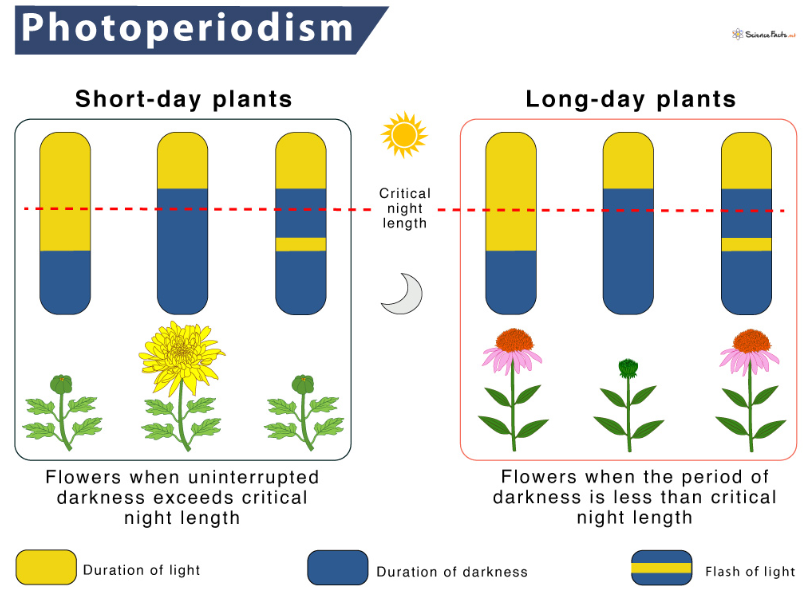
These plants flower when the day is shorter than a certain limit. In many cases, they need a long, unbroken period of darkness. Chrysanthemums, poinsettias, and rice are common examples. Many soybean varieties also show short-day responses.
Long-day plants
These plants flower when daylight lasts longer than their critical limit. Spinach, sugar beet, wheat, and barley are common examples of long-day responses, although the exact behavior depends on the variety.
Day-neutral plants
These plants do not depend strongly on day length to start flowering. Many common tomato and cucumber varieties are treated as day-neutral for flowering, although other growth traits can still respond to light.
How Short-Day Plants Respond
Short-day plants usually flower when nights become long enough. The name can be confusing because many of these plants actually respond to the length of uninterrupted darkness. A brief light signal during the night may prevent flowering in sensitive varieties.
Chrysanthemums are a useful example. Growers can use blackout cloth to create long nights and encourage flower formation. This method is common in commercial flower production because it allows growers to manage flowering time.
Main signal
A short period of daylight followed by a sufficiently long, uninterrupted night.
Common examples
Chrysanthemums, poinsettias, rice, and many soybean varieties.
Practical effect
Long nights can encourage flowering or other short-day growth responses.
How Long-Day Plants Respond
Long-day plants often flower when the days grow longer in spring and early summer. A shorter night can help trigger the flowering process. Some long-day plants respond to the presence of light during a particular part of the day.
Spinach is a useful garden example. As days lengthen and temperatures rise, many varieties begin to form flower stalks. This process is called bolting. Choosing a suitable variety and planting at the right time can help reduce unwanted early bolting.
Main signal
A day that is longer than the plant’s required light period or a night that is short enough for flowering.
Common examples
Spinach, sugar beet, wheat, and barley.
Practical effect
Longer spring days can encourage flowering and reproductive growth.
How Day-Neutral Plants Respond
Day-neutral plants have little or no strict day-length requirement for flowering. Their flowering time may depend more on plant age, temperature, light supply, and overall health.
This does not mean that light is unimportant. These plants still need enough light for photosynthesis and healthy growth. It only means that day length is not the main signal that controls the start of flowering.
Main signal
Flowering depends more on age and other growing conditions than on a fixed day-length limit.
Common examples
Many common tomato and cucumber varieties.
Practical effect
Growers can focus more on light supply, temperature, water, and plant health than on a strict flowering schedule.
Obligate and Facultative Responses
An obligate response means a plant needs a certain light pattern before it can flower. Without that signal, flowering may not happen. A facultative response means the plant can flower without the exact signal, but the right day length makes flowering faster or more likely.
This difference matters when planning a garden. A plant with a strong response may need careful timing. A plant with a weak response may still flower under a wider range of conditions.
Obligate response
The required photoperiod must occur before flowering can take place.
Facultative response
The correct photoperiod speeds up or improves flowering but is not always required.
How Plants Detect Light and Measure Time
Plants use light sensors and an internal clock to detect changes in day length. These systems work together to help the plant decide whether the current light pattern is suitable for flowering or another growth change.
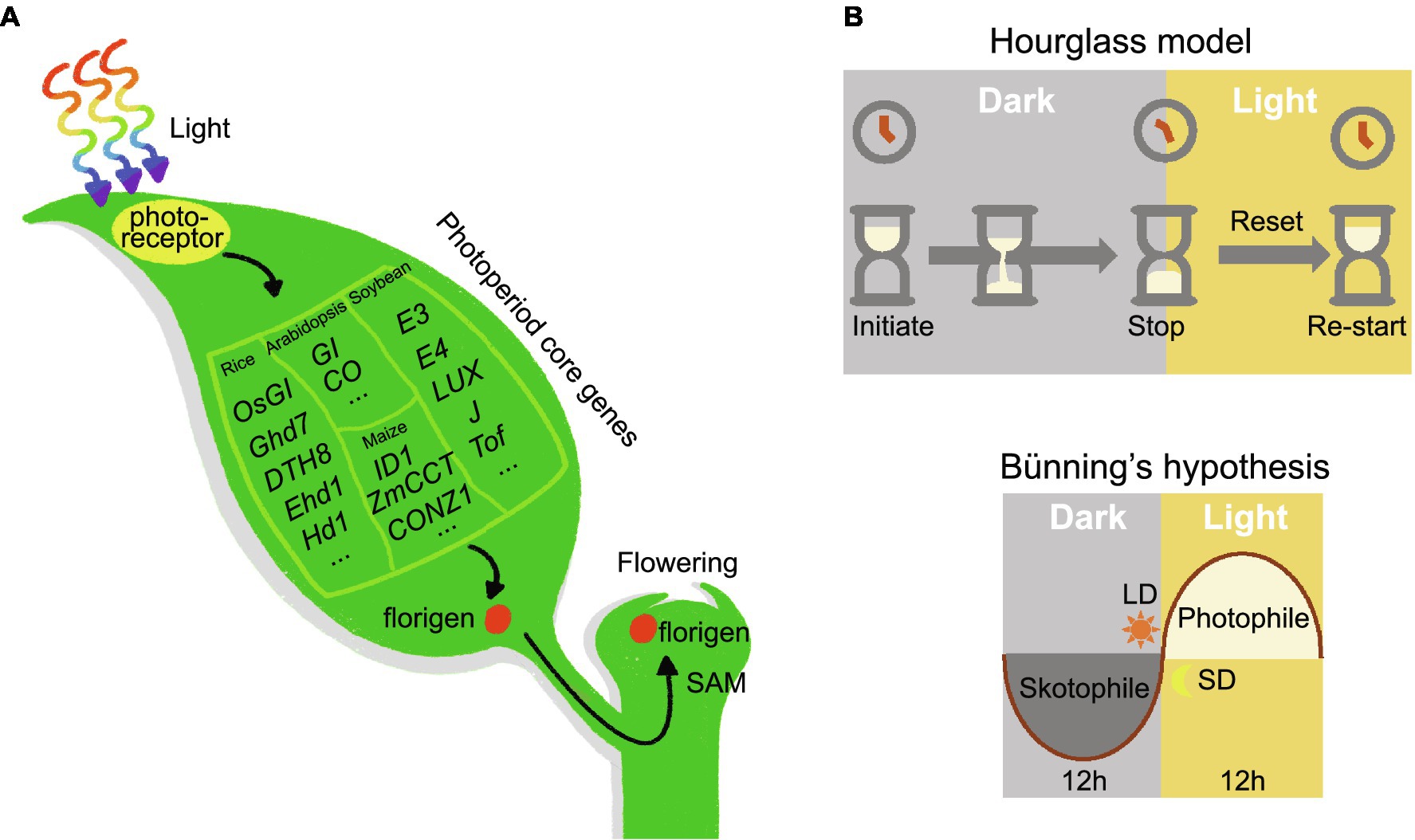
The main light sensors include phytochromes and cryptochromes. Phytochromes respond to red and far-red light. Cryptochromes respond mainly to blue light. These sensors send light information to the plant’s internal control systems.
The circadian clock is an internal rhythm that runs on a cycle of about 24 hours. It helps control when certain genes are active. When the timing of this clock matches a light signal, the plant can start a specific response.
This process is more complex than simply counting hours. The plant must know when light occurs in relation to its internal clock. A light signal at one time of day may have a different effect from the same signal at another time.
Source: pmc.ncbi.nlm.nih.gov
Phytochrome
A light-sensing pigment that responds to red and far-red light. It helps plants read light and dark conditions.
Cryptochrome
A light receptor that responds to blue light and helps link light signals with the plant’s internal clock.
Circadian clock
An internal timing system that helps control daily patterns of gene activity and plant development.
Florigen
A mobile flowering signal made in leaves. In well-studied plants, the FT protein is a key part of this signal.
The Role of Leaves in Flowering
Leaves are major sites where plants detect photoperiod. When the light pattern is right, certain flowering genes become active. One key gene in the well-studied Arabidopsis system is FLOWERING LOCUS T, often called FT.
The FT protein can move from leaves through the plant’s phloem. It travels to the shoot tip, where it helps change the growing point from leaf production to flower formation. This process links a light signal in the leaf with a change in growth at another part of the plant.
The same basic idea has helped researchers understand flowering in several crops. However, the exact genes and control steps differ among species. The Arabidopsis model should not be treated as a complete description of every plant.
Light detection
Leaves receive light signals through special light receptors.
Gene activity
The internal clock and light signals help control flowering-related genes.
Signal movement
A mobile signal can travel from the leaves to the shoot tip.
Flower formation
The shoot tip changes its activity and begins to form flowers.
The External Coincidence Model
The external coincidence model helps explain how plants compare light with their internal clock. The clock creates periods when the plant is more sensitive to light. If light reaches the plant during the right period, it can trigger a response.
For example, a long-day plant may receive light late in the day when a flowering control system is active. This can help promote flowering. A short-day plant may respond in the opposite way, depending on its own genes and light signals.
Internal timing
The circadian clock sets periods of light sensitivity.
External light
The plant receives a light signal at a certain time.
Plant response
The overlap between the clock and light signal can change gene activity and development.
Why Uninterrupted Darkness Matters
For many photoperiod-sensitive plants, the length of uninterrupted darkness matters as much as the length of daylight. This is why a short flash of light at night can change flowering, even when the total amount of light during the day stays the same.
A night break is a short period of light during what would normally be a dark period. It can make a plant respond as if the night were shorter. In many short-day plants, this can delay or prevent flowering. In some long-day plants, it can encourage flowering.
The effect depends on the plant species, variety, light color, and timing. A night break does not affect every plant in the same way. Some plants also respond more strongly when the light occurs at a particular point in the night.
This explains why a low-level lamp can affect a sensitive crop even when it provides too little energy for useful photosynthesis. The plant is reading the light as a signal, not using it as a major source of food.
Short-day response
A night light can interrupt the long dark period and prevent or delay flowering in sensitive plants.
Long-day response
A night light can act like a shorter night and promote flowering in some long-day plants.
Timing
The time of the light pulse can affect how strongly the plant responds.
Light quality
Red, far-red, and blue light can produce different signals through different plant receptors.
Can Streetlights Affect Garden Plants?
Yes, artificial light can affect some sensitive plants. A porch lamp, security light, or nearby streetlight may interrupt the natural night. The effect depends on the plant, the brightness, the distance, and the length of exposure.
A short-day plant near a bright outdoor lamp may fail to receive the long, dark period it needs. If a plant repeatedly fails to flower, check for artificial light before changing fertilizer or pruning. Moving the plant or blocking the unwanted light may help.
Check the light source
Look for porch lamps, security lights, garden lights, and nearby windows.
Check the timing
Notice whether the light stays on during the plant’s natural night.
Protect the dark period
Move sensitive plants or use a suitable light barrier when practical.
Other Plant Growth Changes Caused by Photoperiod
Photoperiod affects more than the time of flowering. It can also change leaf growth, stem length, storage organ formation, seed development, and winter preparation. The exact response depends on the species and the genes that control its growth.
This wider role is useful for understanding crops and garden plants. A plant may not show a clear change in flowering but may still change how it grows or stores food. Researchers have found several light-timing systems that control different parts of plant development.
The effects are not always the same in every species. A short day may slow one plant’s growth but encourage another plant to form a storage organ. This is why it is better to study the needs of each crop rather than apply one rule to all plants.
Source: frontiersin.org
Leaf growth
Day length can affect leaf expansion, cell growth, and the rate at which a plant builds new leaves.
Stem growth
Some plants change stem length and growth patterns under short or long days.
Potato tuber formation
Short days encourage tuber formation in many potato varieties, although responses vary with the crop’s genetic background.
Winter dormancy
Shorter days can help temperate trees stop active growth and form protective buds.
Seed development
Photoperiod-related genes can affect seed development and seed size in some plant species.
Photoperiod and Potato Tuber Formation
Potatoes form tubers as underground storage organs. These organs hold food that helps the plant survive and grow again. In many potato varieties, shorter days encourage the start of tuber formation.
The leaves detect the light pattern and send growth signals to underground stems called stolons. The stolons then begin to form tubers. This process shares some control features with photoperiodic flowering.
However, potato varieties differ in their response. Some modern varieties can form tubers under longer days. Temperature and growing conditions also affect the result, so day length alone cannot explain every crop outcome.
Storage
Tubers store energy and support later plant growth.
Light signal
Leaves read day length and send signals that can affect stolon growth.
Variety effect
The strength of the response depends on the potato variety and its growing conditions.
Photoperiod and Winter Dormancy
Many trees and shrubs in temperate regions use shorter fall days as an early signal of winter. They slow shoot growth and form buds that protect young tissues. This helps reduce the risk of damage during cold weather.
The plant may also change its use of stored energy. Growth slows, and the plant prepares to survive a period when water and energy are harder to obtain. Temperature and other seasonal signals help control this process too.
A tree that begins dormancy is not simply reacting to cold. Day length can provide an early warning before the coldest part of the year arrives.
Growth cessation
The plant reduces active shoot growth as days become shorter.
Bud formation
Protective buds form around sensitive growing points.
Dormancy
The plant enters a resting stage that helps it survive unfavorable conditions.
Photoperiod and Vegetative Growth
The amount and timing of light can affect how fast leaves and stems grow. Some plants produce more leaf growth under long days. Others change their stem length under short days.
Plants also adjust how they use stored starch and sugars during the night. The daily light period affects how much energy they make, while the internal clock helps control when stored energy is used. This links light timing with normal plant growth.
Leaf expansion
The length of the light period can affect the rate at which leaves expand.
Energy use
Plants adjust the use of stored sugars and starch across light and dark periods.
Growth balance
Photoperiod helps coordinate growth with the season and available light.
How to Manage Photoperiod in a Garden or Greenhouse
Growers can manage photoperiod by changing the amount of light or darkness a plant receives. The best method depends on whether the crop needs longer days or longer nights. It also depends on the natural day length at the growing site.
Commercial greenhouses often use artificial lights to extend short winter days. They also use blackout cloth to create shorter days during bright summer periods. These methods help control the time of flowering in crops such as chrysanthemums and poinsettias.
Home gardeners can use the same basic ideas on a smaller scale. The first step is to learn the plant’s exact light needs. A general label such as short-day plant may not provide enough detail for a specific variety.
Source: frontiersin.org
Day extension
Artificial light is added before sunrise or after sunset to create a longer perceived day.
Night interruption
A short period of light is added during the night to change the plant’s perception of darkness.
Blackout cloth
Opaque cloth blocks light and creates a longer dark period for short-day crops.
Start by finding out whether the plant is short-day, long-day, or day-neutral. Check the seed packet, plant label, variety description, or a reliable growing guide. Look for the critical day length if the source provides one.
Do not assume that all varieties of the same crop behave in the same way. Breeding has changed photoperiod sensitivity in many crops. A variety developed for one region may flower at a different time from a variety developed for another region.
Check the variety
Use information for the exact cultivar rather than relying only on the plant species.
Check the growth stage
Some plants respond only after they reach a certain level of maturity.
Step 2: Check Local Day Length
Day length changes with latitude and season. A growing plan that works in northern states may not work in southern states. Use a local sunrise and sunset calendar or a trusted agricultural guide to check the expected light period.
Remember that some plants can sense low light during twilight. The period they perceive may not match the simple time between sunrise and sunset. Nearby buildings, trees, and artificial lights can also change the light reaching a plant.
Location
Check day length for the actual growing area.
Season
Compare light duration during the planned planting and flowering periods.
Light leaks
Look for lamps and other sources that may interrupt darkness.
Step 3: Extend the Day When Needed
Long-day plants may need extra light when natural days are too short. Growers can add light before sunrise or after sunset. A night interruption can also work for some crops.
Use a timer to keep the schedule steady. The lamp must provide a light signal that the crop can detect. A normal household bulb may not give the same result as a suitable horticultural light, so check crop-specific guidance before choosing a lamp.
Photoperiod lighting does not always need to provide enough energy for strong photosynthesis. Some systems use low-level light mainly to change the plant’s timing signal. If the plant also needs more energy, supplemental growing light may be required.
Set a timer
Keep the start and stop times consistent each day.
Choose suitable light
Use a lamp and light spectrum that meet the needs of the crop.
Watch plant growth
Check for changes in flowering, stem growth, and leaf health.
Step 4: Create Longer Nights When Needed
Short-day plants may need a longer period of darkness to flower. Growers can use opaque blackout cloth to block natural light. The cover should go on and come off at the same times each day.
Check the edges of the cover for light leaks. Even a small gap can reduce the quality of the dark period for a sensitive crop. The cloth must also allow safe air movement and prevent excessive heat from building up around the plants.
Remove or open the cover at the correct time. Do not leave plants covered for longer than the crop’s growing plan requires. Heat, poor airflow, and high humidity can cause stress.
Use opaque material
Choose a cover that blocks the light reaching the plant.
Keep the schedule steady
Apply the same dark period each day during the required induction stage.
Protect airflow
Prevent heat and moisture from building up under the cover.
Step 5: Track the Results
Keep a simple record of light hours, temperature, watering, and visible plant changes. Note when flower buds first appear or when growth begins to slow. These records help show whether the light schedule is working.
Change one factor at a time when possible. If you change light duration, temperature, and fertilizer at once, it becomes hard to know which change caused the result. A steady record can make future planting plans more reliable.
Record light hours
Write down the daily start and end times of the light period.
Check plant health
Look for normal leaves, steady growth, and expected flower development.
Compare results
Use past records to improve the next growing cycle.
Factors That Change a Plant’s Photoperiod Response
Day length is only one part of plant development. Temperature, plant age, water supply, light intensity, and genetics can change how a plant responds. These factors may work together rather than act alone.
This is why two plants under the same light schedule may not flower at the same time. One may be older or more mature. Another may have a different genetic response or may have received a different amount of cold during winter.
A good growing plan considers all major conditions. Changing the light schedule without checking the rest of the growing environment can lead to poor results.
Temperature
Heat and cold can speed up or slow down flowering and other growth changes. High temperatures may also cause early bolting in some crops.
Plant age
Some plants must reach a mature stage before they can respond to the correct day length.
Genetics
Different varieties can have different critical day lengths and different levels of sensitivity.
Light intensity
A plant needs enough useful light for photosynthesis, even when a low light level can provide a photoperiod signal.
Water and nutrients
Stress from poor water supply or low nutrients can limit growth and flowering even when the light schedule is correct.
Photoperiod Versus Vernalization
Photoperiod and vernalization are two different seasonal signals. Photoperiod is based on the length of light and dark periods. Vernalization is the effect of a long period of cold on a plant’s ability to flower.
Some plants need both signals. Certain winter wheat varieties need a period of cold before they can flower normally. Longer spring days may then help start the next stage of development.
This difference matters when a plant fails to flower. Giving it more light will not replace a cold period if the variety has a true vernalization requirement.
Photoperiod
A seasonal signal based on the duration of light and darkness.
Vernalization
A flowering response that requires a suitable period of cold.
Combined response
Some plants need both the right cold exposure and the right day length.
Photoperiod Versus Daily Light Integral
Daily light integral, or DLI, is the total amount of photosynthetically useful light a plant receives during one day. It is often measured in moles of light per square meter per day. It describes the plant’s daily light supply, not simply the number of hours of daylight.
Photoperiod and DLI can change independently. A plant may receive 16 hours of weak light but still get too little energy for strong growth. Another plant may receive a shorter period of intense light and capture more energy.
Growers should check both values when using indoor lights. Photoperiod helps control timing, while DLI helps explain whether the plant receives enough light for healthy growth.
Photoperiod
Measures how long the plant receives a light signal.
DLI
Measures the total amount of photosynthetic light received over the day.
Growing decision
Use both measures when a crop needs a specific flowering schedule and enough light for strong growth.
Common Photoperiod Problems and How to Fix Them
When a plant does not flower or grow as expected, check its light schedule first. Then check temperature, age, water, and nutrients. A simple step-by-step check can help find the cause without making several changes at once.
Do not assume that every flowering problem comes from the wrong day length. Some plants need a cold period, while others need more time to mature. A damaged root system or poor growing conditions can also delay flowering.
Problem: A short-day plant does not flower
Possible causes include a night light, light leaking through blackout cloth, an insufficient dark period, or a plant that has not reached the right age. Check the full night schedule and the exact variety requirement.
Problem: A long-day plant flowers too late
Possible causes include days that are too short, weak or unsuitable artificial light, or a variety with a different flowering requirement. Check the crop’s light needs before extending the day.
Problem: A leafy crop bolts too early
Long days and warm temperatures can encourage early flowering in sensitive crops such as spinach. Choose a suitable variety and use a planting time that matches the local season.
Problem: A plant grows slowly under long days
The light period may be long but the light intensity may be too low. Check the daily light supply, plant health, root condition, and nutrient levels.
Problem: Plants become stressed under blackout cloth
Poor airflow and trapped heat may be the cause. Check ventilation, cover material, and the time the cover stays in place.
A Simple Photoperiod Troubleshooting Order
Start with the least costly checks. Confirm the plant variety and its flowering group. Then measure the natural light period and inspect the area for unwanted light at night.
Next, check the plant’s age and the temperature during the growing period. If the variety needs cold exposure, check whether it received enough. Finally, review water, soil, root health, and nutrient supply.
If the problem continues, use a local university extension guide or a crop-specific growing manual. Commercial crops may need a more exact lighting plan than a home garden.
First
Confirm the species, variety, and photoperiod requirement.
Second
Check natural day length, artificial light, and unwanted night light.
Third
Review temperature, plant age, and any cold requirement.
Fourth
Check water, nutrients, roots, and signs of stress.
Finally
Change one factor at a time and record the plant’s response.
Important Questions to Ask Before Changing a Light Schedule
A useful photoperiod plan starts with the right question. Knowing whether a plant is short-day or long-day is helpful, but it may not be enough. The exact variety, growth stage, and local conditions can change the best approach.
A focused research review checked on November 16, 2026, covered United States greenhouse guidance and plant-science research. The reviewed material included UMass Extension, UF/IFAS, and research reviews on circadian timing and wider plant growth responses. The extension guides explain practical light control, while the research reviews give more detail on flowering signals and other growth changes.
The questions below are inferred next needs based on the growing decisions readers may face. They are not verified search-volume findings. They also show where a short general guide may need more crop-specific detail.
What is the critical day length for my exact variety?
Reader stage: Before planting. Basis: Inferred next need. Reviewed coverage: Shallow. General extension guides explain critical day length, but a grower still needs the correct value for the exact variety. Reader benefit: Better planting dates and more reliable flowering. Evidence needed: Seed supplier or crop-specific extension data. Priority: High. Placement: Plant classification and growing guide sections.
Can porch lights or streetlights affect flowering?
Reader stage: During growth. Basis: Inferred next need. Reviewed coverage: Shallow. Extension guidance explains light sensitivity and night interruption, but does not give one universal limit for every outdoor setting. Reader benefit: Find unwanted light before changing fertilizer or pruning. Evidence needed: Crop-specific light sensitivity data. Priority: High. Placement: Night interruption and troubleshooting sections.
Does my plant need cold as well as the right day length?
Reader stage: Before flowering. Basis: Inferred next need. Reviewed coverage: Shallow. Research reviews explain interactions between seasonal signals, but basic growing guides may not give a simple crop decision. Reader benefit: Avoid trying to replace a cold requirement with artificial light. Evidence needed: Variety-specific vernalization guidance. Priority: High. Placement: Factors that change photoperiod response.
Why does a plant grow leaves but fail to form flowers?
Reader stage: Troubleshooting. Basis: Inferred next need. Reviewed coverage: Missing from the short overview pages. Reader benefit: Separate light problems from plant age, temperature, and stress. Evidence needed: Crop-specific flowering requirements and growing conditions. Priority: High. Placement: Troubleshooting section.
Does day length affect tubers and winter buds too?
Reader stage: After learning the flowering basics. Basis: Inferred next need. Reviewed coverage: Answered in research reviews but shallow in basic greenhouse guides. Reader benefit: Understand why photoperiod matters beyond flowers. Evidence needed: Crop and species studies on storage organs and dormancy. Priority: Medium. Placement: Other plant growth changes section.
Frequently Asked Questions
Q
What are plant photoperiod responses?
Plant photoperiod responses are changes in growth and development caused by the length of daylight and darkness. They help plants control flowering, leaf growth, storage organ formation, and winter dormancy. The response depends on the species and variety.
Q
Do plants measure daylight or darkness?
Plants can use both light and dark signals. Many flowering plants are highly sensitive to the length of uninterrupted darkness. Others respond more directly to light during a certain part of the day. The exact timing system differs among species.
Q
Can artificial light prevent a plant from flowering?
Yes. Artificial light during the night can interrupt the dark period needed by some short-day plants. This may delay or prevent flowering. The effect depends on light intensity, color, timing, and plant type.
Q
What is the difference between a short-day and a long-day plant?
A short-day plant flowers when days are shorter than its critical limit and nights are long enough. A long-day plant flowers when days exceed its critical limit or nights become short enough. Neither group simply means that the plant needs less or more total light for healthy growth.
Q
Can I change a plant’s flowering time with grow lights?
Yes, in some plants. Growers can extend the day with artificial light or create longer nights with blackout cloth. However, the correct schedule depends on the variety and its flowering needs. Some plants also need a suitable temperature or cold period.
✦ Wrapping Up
Conclusion
Plant photoperiod responses help plants match their growth to the changing seasons. Light and darkness work with the plant’s internal clock to control flowering, leaf growth, storage organs, and dormancy. These responses allow plants to prepare for the conditions that lie ahead.
The three main flowering groups are short-day, long-day, and day-neutral plants. Each group has different needs. Temperature, plant age, genetics, and light supply can also change the result. Understanding these factors makes it easier to plan planting dates and manage indoor or outdoor growing conditions.
For gardeners and growers, the best approach is to start with the exact plant variety. Check its light needs, follow the local seasonal pattern, and watch how it grows. Use artificial light or blackout cloth only when the crop needs a controlled day or night schedule.
💡 Key Takeaway
Identify your plant variety, find its photoperiod requirement, and compare that need with local day length. Check for unwanted light at night, monitor temperature, and keep a simple record of growth and flowering. Change one growing condition at a time so you can see what works.